On page 248 of my book on practical privacy for web developers, I gently implored my readers not to be That Person. By that, I mean, That Person who slags off a well-written news article about privacy because of the adtech on the page which delivers the article; after all, the person who wrote the article had no choice in the matter.
Yeah, so, about that.
Forget that I ever said it.
Here’s why.
In light of this week’s events in the US, Wired has written an article on how to protest safely in the age of surveillance.
As they should.
They’re so proud of this that they dropped the paywall.
We’ve removed the paywall from this guide so everyone can access it. 👇 Stay safe.
— WIRED (@wired.com) 8 January 2026 at 18:35
Spot the problem here, folks.
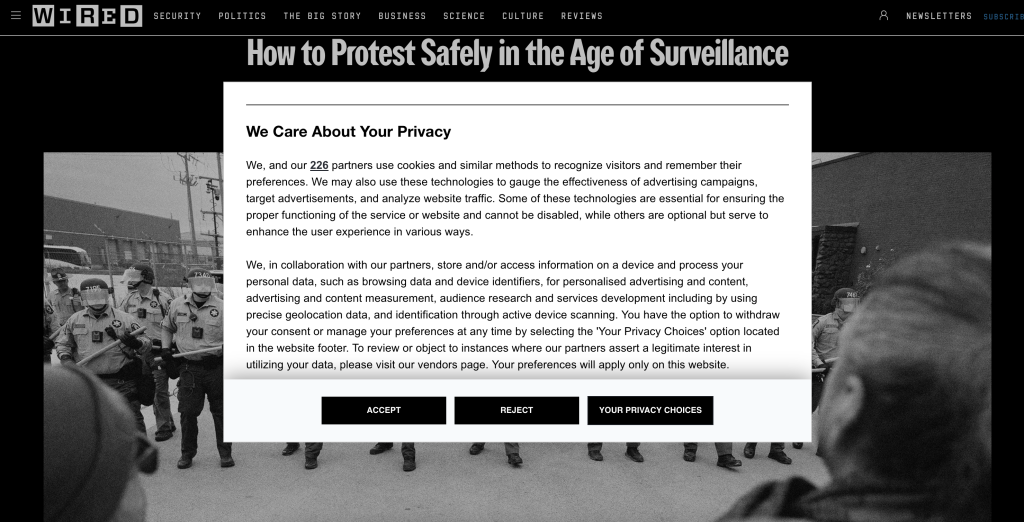
I had to relinquish everything I said on page 248 and become That Person.

You read that 404 piece, right?
Right?
The one which explains how ICE is working from a legal rationale which states that if a device is collecting adtech or location data, and that data is then sold (either by the adtech provider or by a data broker) to ICE, because the owner did not change their universal privacy settings or trigger the toggles in the cookie popup, then the owner relinquished their Fourth Amendment rights.
As 404 wrote:
The ACLU obtained an internal ICE legal analysis on the use of smartphone location data through a Freedom of Information Act (FOIA) lawsuit. At the time it was written it was discussing data from another location broker. But it provides insight into ICE’s legal justification to not seek a warrant when using such data. 404 Media has uploaded a copy of the document here.
“Under longstanding Supreme Court precedent, an individual has no reasonable expectation of privacy under the Fourth Amendment in information voluntarily disclosed to third parties,” the analysis says, referring to data collected by location data companies and sold to the government. The rationale is that the phone’s owner has provided this information willingly because they could, theoretically, remove apps gathering their location data or turn off location services altogether. (In multiple investigations into the location data industry, I’ve found apps did not always disclose how their location data might be used or sold, and in some cases apps still collected data even when people opted-out, meaning users could not have meaningfully consented.)
I have spent years being diplomatic and polite about the hypocrisy of adtech in the wider privacy education context but as of this week, I hereby drop it.
This is how it is.
If you are running guides to safe protest, countersurveillance, or personal/operational security, but you have not done a thing about the adtech on the page, you are not helping your readers, you are harming them.
If you are virtue signalling about dropping your paywall but keeping several dozen location data trackers on the article, you are not on the side of your readers, you are on the side of fascism.
If you think you’re on the right side with the words you write, but choose to remain on the wrong side for the purposes of not pissing off your marketing department, you are complicit.
Do not claim to look your readers in the eye and tell them you are offering them advice for resistance when what you are actually doing is building a honeypot for the very people who can, would, and will shoot your readers at point blank range.

